AI Agents and Self-Healing Analytics: Exploring Qlik’s Active Intelligence
Explore how Qlik's Active Intelligence is revolutionizing business analytics by leveraging AI agents for 'self-healing' capabilities. Unlike traditional BI systems that react to issues, Qlik proactively monitors data flows and analytics pipelines in real-time. Intelligent agents detect anomalies and automatically initiate corrective actions, ensuring uninterrupted, reliable insights. This approach minimizes downtime, reduces manual monitoring, and enhances data accuracy, leading to significant cost efficiencies and productivity gains. Discover real-world examples from the manufacturing and public sectors, where Qlik's Active Intelligence has drastically improved operational efficiency and decision-making. Learn how Qlik's self-healing analytics differ from traditional BI monitoring and understand its suitability for mission-critical, real-time environments. The future of BI points towards fully autonomous systems with generative AI integration and adaptive learning, promising even greater agility and accuracy in analytics-driven decisions
In our previous discussion on Pyramid Analytics, we explored how AI agents significantly enhance decision intelligence through advanced predictive capabilities and proactive insights. This innovative approach showcased how intelligent automation could lead to more effective and streamlined decision-making processes. Building upon this theme, we now turn our attention to Qlik’s Active Intelligence—an evolution of business intelligence (BI) that leverages AI to offer "self-healing" analytics. With Qlik, organizations benefit from BI platforms that not only predict and detect issues in real-time but proactively fix them before disruptions occur.
What is Qlik’s Active Intelligence?
Qlik’s Active Intelligence represents a groundbreaking approach to analytics, combining real-time data integration with sophisticated AI-driven monitoring and automation. Unlike traditional BI systems, which often reactively address issues after they've impacted the business, Active Intelligence uses embedded AI agents to continuously monitor data flows, dashboards, and analytics pipelines.
At the heart of this system are intelligent agents that autonomously detect anomalies, disruptions, or inaccuracies, instantly initiating corrective actions without human intervention. By constantly analyzing data patterns, pipeline behavior, and system health indicators, Qlik ensures an uninterrupted, reliable flow of actionable insights, allowing business users to maintain confidence in their analytics-driven decisions at all times.
Core Benefits of Self-Healing Analytics
Implementing Qlik’s AI-powered Active Intelligence delivers several key advantages:
AI agents provide real-time surveillance across complex data flows. They identify deviations or unexpected data volume shifts immediately, triggering automated corrective workflows or alerts for human intervention.
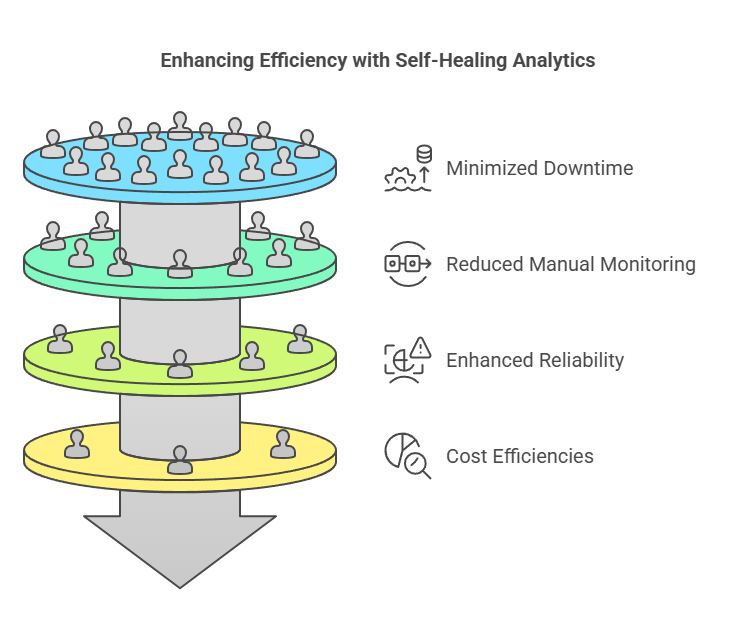
Minimized Downtime: AI agents proactively detect potential disruptions and address them in real-time, significantly reducing system downtime and ensuring seamless analytics availability.
Reduced Manual Monitoring: Self-healing analytics dramatically cuts down on manual oversight. Analytics teams spend less time troubleshooting and more on strategic analysis and innovation.
Enhanced Reliability and Accuracy: Automated error detection and correction significantly boost the accuracy and reliability of analytics outputs. Decision-makers gain consistent, trustworthy insights.
Cost Efficiencies and Productivity Gains: Reducing downtime and manual troubleshooting translates directly into cost savings. Teams become more productive, analytics become more efficient, and organizations realize substantial operational benefits.
Real-world Examples: Qlik's Active Intelligence
Example 1: Private Sector – Manufacturing Industry
Consider a global manufacturing firm heavily reliant on integrated supply-chain data for daily operations. Previously, any disruption in data integration—such as a broken pipeline or schema mismatch—could halt analytics, causing costly delays and inefficiencies.
Implementing Qlik’s Active Intelligence enabled AI agents to continuously monitor data flow and predictively identify potential disruptions, such as mismatched schemas, delayed data transfers, or abnormal fluctuations in inventory data. Once detected, the system autonomously executed corrections, such as automatic schema alignment, data validation, or rescheduling data refresh cycles.
Results:
Reduced downtime in data pipelines by approximately 80%
Significantly improved accuracy in inventory forecasting
Saved hundreds of hours annually in manual troubleshooting
Example 2: Public Sector – Smart City Management
A prominent city administration adopted Qlik’s Active Intelligence to manage complex data streams from public utilities, traffic systems, emergency services, and environmental monitoring sensors. Previously, data interruptions or inaccuracies led to delays and errors in public service management.
With Qlik’s self-healing analytics, AI-driven agents monitored city-wide data integration in real-time, automatically detecting anomalies such as inconsistent sensor data, unexpected traffic congestion patterns, or interruptions in emergency response data. Immediate corrective actions, such as sensor data recalibration or automatic rerouting of data streams, maintained consistent, accurate analytics for city officials.
Results:
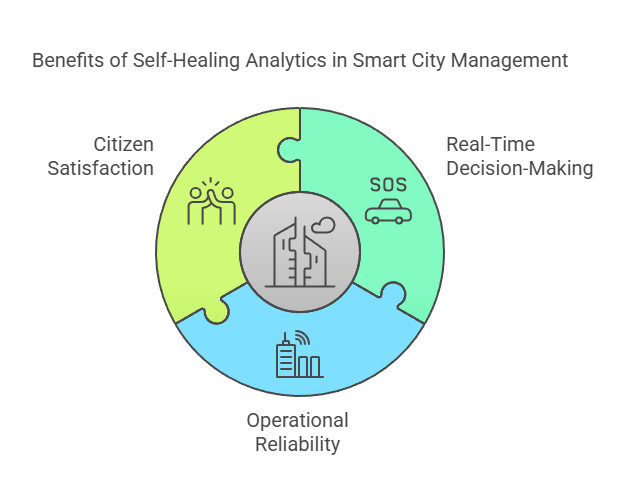
Improved real-time decision-making in public safety
Increased operational reliability of city infrastructure analytics
Enhanced citizen satisfaction through uninterrupted public service delivery
Example 2: Public Sector — Municipal Data Management System
A large municipal authority needed an efficient method to handle complex data pipelines linking various city services, including public transport schedules, utility management, emergency response, and resident feedback data.
Implementing Rivery with AI agents allowed the municipality to automate real-time integration of data streams from multiple city departments. AI-driven anomaly detection identified potential inaccuracies or interruptions in public transportation schedules or utilities usage data almost instantly, triggering automatic remediation actions.
For example, during a significant city event or unforeseen weather event, data patterns dramatically shifted. AI agents automatically recognized the deviation, scaled ETL resources dynamically, and adjusted reporting frequencies proactively.
Results:
Reduced pipeline downtime by over 75%
Enhanced reliability and accuracy of municipal reports and dashboards
Improved public trust by providing reliable, real-time city information.
The Future of Self-Healing Analytics and BI
The trajectory for self-healing analytics points toward increasingly sophisticated, autonomous BI ecosystems. Looking forward, we anticipate a future where platforms like Qlik will integrate even more advanced capabilities, including:
Fully Autonomous BI: Future systems may become largely self-sufficient, anticipating needs, autonomously adapting analytics strategies, and automatically aligning BI outputs with evolving business goals.
Generative AI Integration: Integrating generative AI can empower BI platforms to not only predict but also recommend advanced, prescriptive business scenarios and strategies, significantly enhancing decision-making quality.
Adaptive Learning and Scenario Modeling: Continuous adaptive learning by AI agents means they’ll refine predictive accuracy, dynamically improve anomaly detection capabilities, and facilitate automated, real-time scenario modeling tailored to evolving business environments.
Final Thoughts
Qlik’s Active Intelligence and self-healing analytics illustrate the remarkable evolution of AI and BI synergy, building upon the foundation laid by enhanced decision intelligence platforms such as Pyramid Analytics, as explored in our previous article. By proactively identifying and rectifying issues, Qlik not only boosts operational efficiency but fundamentally transforms how businesses interact with data.
As organizations increasingly leverage AI-driven, self-healing analytics, we can expect to see not only reductions in downtime and maintenance costs but also profound improvements in decision-making agility and accuracy. The future is bright for businesses embracing this new era of intelligent, proactive analytics.
How does Qlik’s self-healing analytics differ from traditional BI monitoring?
How complex is the integration of AI agents into existing Rivery data pipelines?
Traditional BI monitoring relies heavily on manual intervention, where users react after problems occur. Qlik’s Active Intelligence proactively detects and corrects issues through AI-driven automation, preventing disruptions before they affect business processes.
What makes Qlik’s Active Intelligence suitable for real-time environments?
Active Intelligence continuously monitors analytics in real-time, using AI to detect patterns indicating potential issues. The platform’s built-in predictive and corrective capabilities ensure immediate resolution, making it ideal for environments requiring uninterrupted, real-time decision-making.
Are self-healing analytics reliable enough for mission-critical decisions?
Yes. Qlik’s AI-driven analytics undergo rigorous validation, leveraging transparent algorithms and explainable AI practices. Organizations receive clear diagnostics and automated corrections, ensuring reliability for even the most mission-critical analytics use cases.